Florida law treats pool fencing as a child safety structure, not just a property boundary. The penalties for non-compliance are real: failed inspections, code-enforcement fines, and — in the worst case — civil and criminal liability if a child accesses an unprotected pool. The good news is that the code is actually clear once you read it. Here's what every pool owner needs to know.
The governing law
Florida Statute 515.27 — the Residential Swimming Pool Safety Act — defines pool barrier requirements. Local building codes (Broward County in our case) layer additional requirements on top of the state minimum. Where the local code is stricter, the local code wins.
The 4-foot rule
Any residential pool must be enclosed by a barrier at least 48 inches (4 feet) high, measured from the side of the barrier facing away from the pool. Sounds simple, but the way the height is measured matters:
- If the ground slopes, the barrier height is measured from the highest ground level within 3 feet of the barrier on the outside.
- The barrier cannot have any gap larger than 4 inches between the bottom rail and the ground.
- Gaps in the fence body cannot exceed 4 inches anywhere.
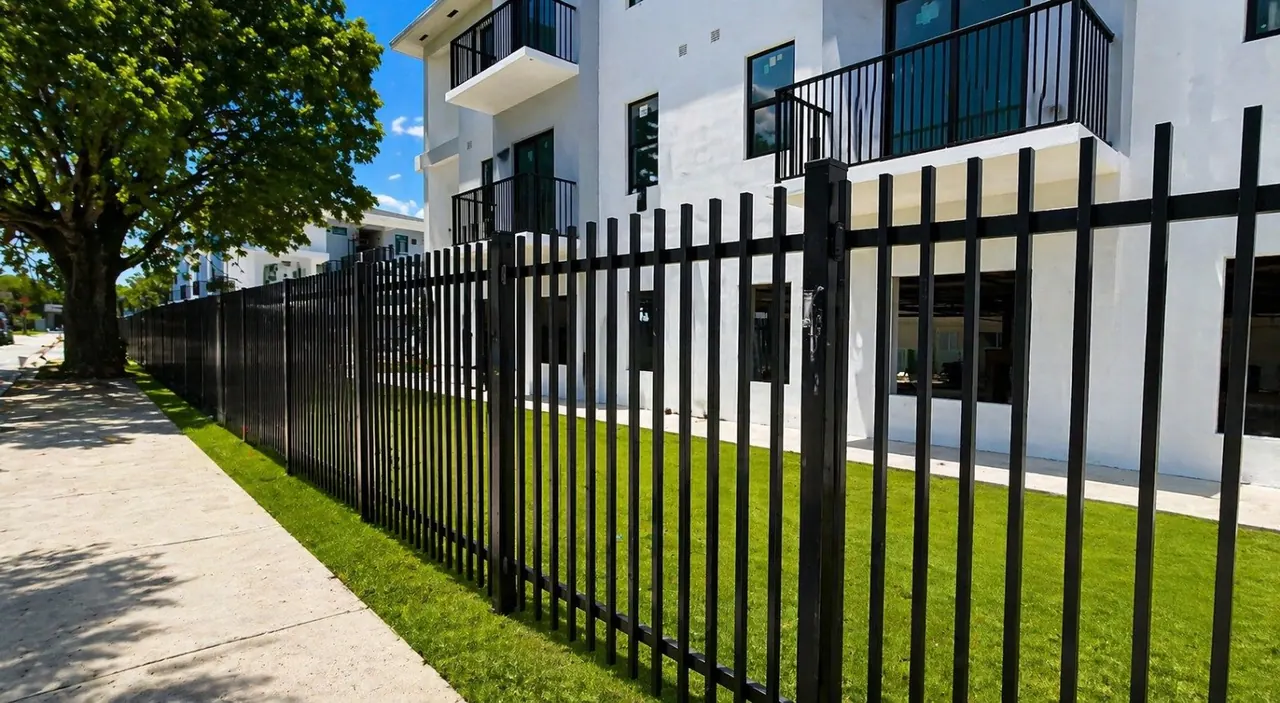
In practice this means we install pool fences with picket spacing of 4 inches or less, often closer to 3.5 inches, with bottom rails set within 2 inches of grade.
Gate hardware: where most homeowners fail
The gate is the most common code failure point. By statute, every pool gate must be:
- Self-closing. When opened and released, it returns to the closed position without manual help.
- Self-latching. The latch engages automatically when the gate closes.
- Latch height: 54 inches minimum from grade on the pool-side, OR within 3 inches of the top of the gate on the inside if the gate has no openings the latch can be reached through.
- Outward-swinging. Gates must swing away from the pool area.
- Lockable. A key or combination lock must be installable when not in use.
Spring-loaded hinges and magnetic latches are the standard. We use commercial-grade hardware on every pool install — bargain hardware fails within months in Florida humidity and triggers re-inspections.
What about screen enclosures?
A screen enclosure can serve as the barrier if and only if:
- The enclosure is permanent, not seasonal.
- It meets the 48-inch height requirement at every point.
- All access doors meet the gate hardware requirements above.
If your enclosure has a low knee-wall section that's under 48 inches, it does not qualify on its own — you'll need a perimeter barrier as well.
Need a code-compliant pool fence fast?
We install Florida pool-code-compliant aluminum fencing with the right gate hardware on every install. Pre-final-inspection turnaround in as little as 5 business days.
The inspection checklist
When the inspector shows up for final, they walk the entire perimeter and check:
- Height at every section (with a tape measure on the outside face).
- Picket gaps with a 4-inch test sphere.
- Bottom-of-fence-to-grade gap.
- Gate self-close from full-open position.
- Gate self-latch from a 6-inch open position.
- Latch height from grade.
- Gate swing direction.
- Lock functionality.
- Wall-mounted alarms (if pool door from house leads to pool area).
If any single item fails, you fail the inspection — and have to schedule another one. The fix is usually trivial; the time loss isn't.
Common DIY mistakes
- Installing a wood gate that warps within a season — gate frames must stay square or self-latch fails.
- Using residential-grade hinges that lose tension — spring fails, gate stops self-closing.
- Installing the latch at 48 inches because the fence is 48 inches — minimum latch height is 54.
- Forgetting that a pet door in the house leading to the pool area also requires alarming.
Pool code is one area where the cost of cheap shortcuts is genuinely too high. A failed inspection costs days; a child accessing the pool through a non-compliant gate costs everything. Get it right.