We get this question every week: "What lasts longest down here?" The honest answer is more nuanced than the brochure copy makes out, because "longest" depends on what's hitting your fence — sun, salt, humidity, storm winds, lawn equipment, dog teeth, kids on bikes — and how much maintenance you're willing to do.
After 23 years installing every common material across Broward County, here's what we've watched fail and what we've watched outlive its warranty. No marketing fluff — just what holds up.
Vinyl (PVC) — the set-and-forget option
UV-stabilized vinyl is the closest thing we install to a maintenance-free fence. It does not rot, rust, splinter, fade meaningfully under proper UV inhibitors, or attract termites. We have 18-year-old vinyl installs in Plantation that look like they did at year three.
Strengths:
- Salt air doesn't touch it — perfect for coastal properties.
- Hurricane-rated panels exist for 175 mph wind code (we install these as standard).
- Cleaning is a hose and dish soap, twice a year.
- 20-50 year manufacturer warranties on premium SKUs.
Weaknesses:
- Bargain-grade vinyl yellows and gets brittle under Florida sun within 6-8 years. The polymer matters — ask for the spec sheet.
- Damage usually means replacing a whole panel, not patching.
- Limited color options without paying a premium.
Aluminum — the structural workhorse
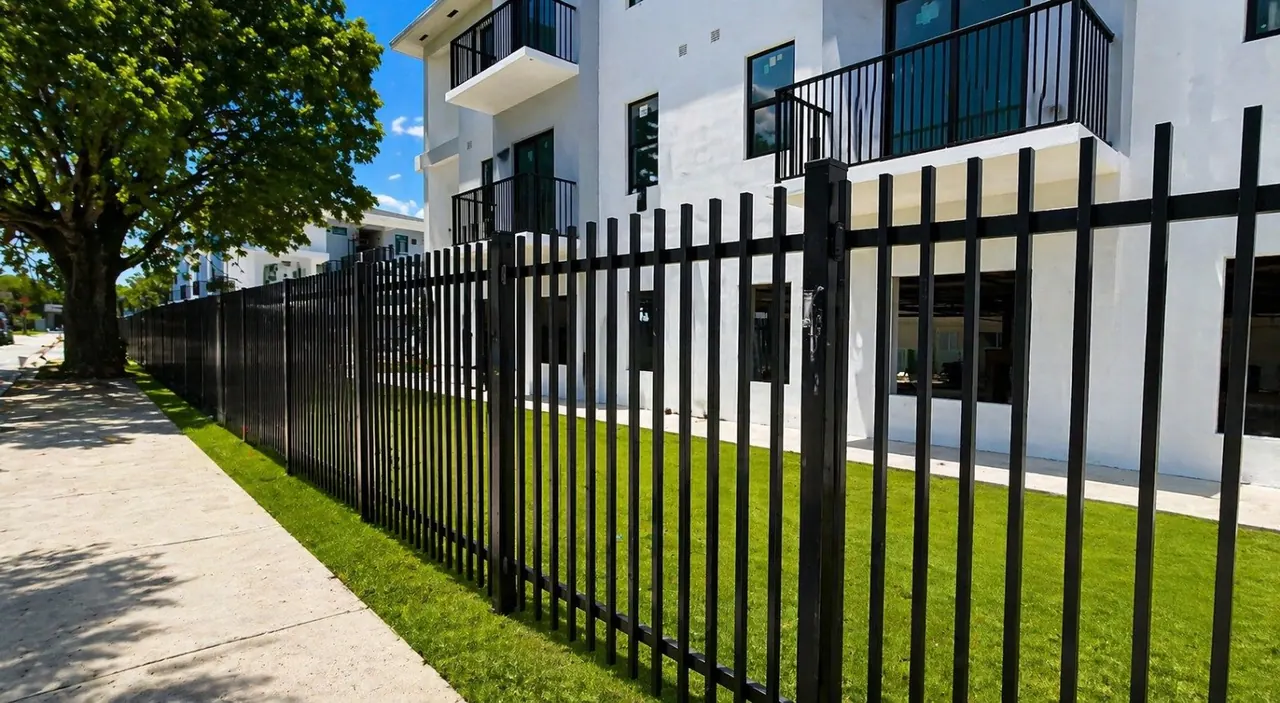
Powder-coated aluminum (we use 6063 alloy) is what we install when a property needs strength and longevity at the same time. It will not rust — even oceanfront. It survives storms because it's open-picket: wind passes through, rather than fighting it.
Strengths:
- Effectively immune to coastal corrosion when properly powder-coated.
- Hurricane performance is excellent — open profile means less wind load.
- Pool-code compliant out of the box (with the right picket spacing).
- 30+ years of usable life is realistic. We've removed 25-year-old aluminum that was reusable.
Weaknesses:
- Not a privacy fence — you see through it.
- Powder coat can chip if struck hard (lawn mowers, weed trimmers). Touch-up is straightforward but not invisible.
- Higher upfront cost than vinyl or wood.
Wood — the warm option that needs work
A pressure-treated pine or western red cedar fence is beautiful, character-rich, and absolutely survivable in South Florida — but only with maintenance. Untreated and unmaintained, wood will fail here in 5-7 years. With the right install and yearly attention, we have wood fences past 18 years still standing strong.
Strengths:
- Lowest upfront cost per linear foot.
- Aesthetic warmth that no other material matches.
- Easy to repair board by board — you don't replace whole panels.
- HOAs typically prefer it over aluminum or vinyl in older neighborhoods.
Weaknesses:
- Annual or biennial sealing is non-negotiable for longevity.
- Termites are a real concern unless properly pressure-treated.
- Posts are the weak point — even with a "wood fence" we usually pour 36-inch concrete and use steel post inserts.
- Salt air accelerates degradation — within a half-mile of the coast, plan for 8-10 years rather than 15-20.
Not sure which material fits your property?
Coastal exposure, HOA rules, kids and pets, sun angle, and your maintenance tolerance all change the answer. We'll come measure and walk you through what we'd actually choose for your lot.
Side-by-side: 10, 15, and 20 years out
Assuming proper installation and average maintenance:
- At 10 years: Vinyl looks new. Aluminum looks new. Wood needs its second sealing and a few replaced pickets.
- At 15 years: Vinyl may have minor color fade (premium grades less so). Aluminum still looks new. Wood is showing its age — needs more substantial board replacements.
- At 20 years: Vinyl: most still standing, some panels need replacing. Aluminum: still structurally sound, may need a powder coat refresh in coastal zones. Wood: typically time for a full replacement.
The bottom line
If you want low-maintenance privacy and you're not coastal, vinyl is the most predictable long-term value. If you're within a mile of the ocean or you want lifetime-grade structure, aluminum is worth the premium. If you love the look of wood and you'll actually maintain it, wood is fine — just budget for the upkeep and don't cheap out on the post installation.
The honest mistake homeowners make isn't picking the "wrong" material. It's picking a low-end version of any of these three. A premium aluminum fence outlasts a bargain vinyl by decades. A pressure-treated cedar fence with steel-reinforced posts outlasts a hollow vinyl in a windstorm. Spec matters more than category.