Every June through November, we get the same calls. "My fence blew down — can you come tomorrow?" After 22 years and hundreds of post-storm site visits across Broward County, we've seen every failure mode there is. Almost every one was preventable.
This isn't a generic "tie down loose objects" hurricane checklist. This is a fence-specific guide built from forensic investigation of what actually fails during 100-160 mph winds in South Florida — and what holds. If you remember nothing else from this article: fences fail at the post-to-ground connection 80% of the time, not at the panels.
What actually fails in a hurricane
Walk any neighborhood after a major storm and you'll see three patterns of fence damage:
- Posts uprooted from shallow footings. The fence is leaning at 30-45 degrees, with concrete bases pulled out of the ground entirely. This is the most common failure and almost always points to footings less than 24 inches deep, or footings poured without rebar reinforcement.
- Panels separated from rails. The posts are still standing but the panels themselves are gone — usually found a few yards away. This is hardware failure: galvanized nails or screws backing out as the panels flex in the wind.
- Cross-grain failure on wood pickets. The picket fractures along the wood grain mid-board. Almost always seen with builder-grade lumber that was never pressure-treated for South Florida's humidity.
Notice what's not on this list: hurricane-rated vinyl panels splitting, powder-coated aluminum cracking, or properly-installed chain link mesh failing. Those simply don't happen at category 3-4 wind speeds. The failure point is always the connection between the structure and the ground.
The 36-inch concrete rule
Florida's High Velocity Hurricane Zone (HVHZ) building code requires fence posts to be set in concrete footings minimum 24 inches below grade. We pour 36 inches on every install. Here's why those extra 12 inches matter:
"A fence post is a lever. The longer the post above ground, the more force is applied at the base during high wind. Every additional inch of footing depth multiplies the holding power exponentially."
For a standard 6-foot fence in 130 mph sustained winds, the calculated load at the post base is roughly 1,800 pounds of horizontal force. A 24-inch footing in undisturbed sandy soil resists about 2,200 pounds. A 36-inch footing in the same soil resists about 4,800 pounds. That's the difference between a fence that survives and one that ends up across the street.
How to check your existing footings
You don't need to dig up your fence to assess it. A few quick checks:
- Push test: Apply firm pressure to the top of a fence post. If you can move the post more than half an inch in any direction, the footing is failing.
- Crack inspection: Look at the concrete pad around each post. Hairline radial cracks are normal. Multiple cracks longer than 4 inches indicate the footing has shifted.
- Visual lean: Sight down the fence line from each end. Even a 2-degree lean indicates a footing issue and predicts catastrophic failure in the next storm.
Need a pre-storm inspection?
We do free pre-hurricane fence inspections during May and early June. We assess footings, hardware, panel integrity, and gate operators — and give you a written report of any urgent fixes.
Pre-storm checklist (1 week out)
Once a named storm enters the cone, you have about 5-7 days. Here's what to do, in priority order:
- Secure or remove anything attached to the fence. Privacy slats, decorative panels, hanging planters, lights, signs. These act as wind sails and dramatically increase the load on posts. Vinyl-slat privacy sections are especially destructive — remove them entirely if possible.
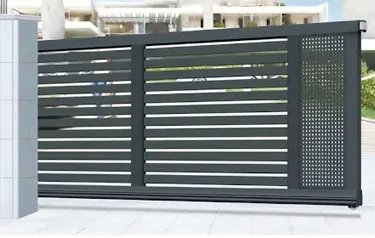
- Open gates partially. Counterintuitive, but a closed gate becomes a sail. Lock automated gates in the "open" position with the manual override (every UL325-compliant gate has one). The hinges and post are designed to handle wind perpendicular to the panel, not parallel.
- Inspect hardware visually. Walk the entire fence line and look for backed-out screws, missing nails, loose brackets. Replace anything questionable with stainless steel hardware.
- Photograph everything. Take date-stamped photos of every section of fence before the storm. If anything fails, you'll need this for insurance claims.
What not to do
A few things we see homeowners attempt that make things worse:
- Don't add bracing. 2x4s wedged against fence posts to "stabilize" them actually increase the load profile and concentrate force at the wrong points. The fence was engineered as a system; ad-hoc additions weaken it.
- Don't tarp the fence. Plastic tarps catch wind like sails. Even loose tarping creates sustained lateral force. Tarps are for roofs, not fences.
- Don't dump sandbags around posts. The footing depth matters more than surface weight. Sandbags do almost nothing for resistance to lateral wind force.
Post-storm: what to inspect
After the storm passes and you're cleared to inspect property:
- Look for hidden post failures. A fence that looks intact may have shifted footings. Repeat the push test on every post.
- Check gate operators. Even IP67-rated motors can fail if water pooled around the housing. Test all functions before assuming they work.
- Examine panel-to-post connections. Pull on each panel firmly. If it shifts or rattles, the connection has loosened and will fail in the next event.
- Look for crack propagation. Hairline cracks that didn't matter before may have grown into structural issues.
Most importantly: document damage immediately. Insurance claims for fence damage are routinely denied or underpaid because homeowners couldn't prove the damage was storm-related vs. pre-existing. Photographs with metadata timestamps are gold for claim disputes.
The bottom line
A properly engineered fence in South Florida should survive any storm short of an EF4 tornado direct hit. If your fence has failed in past hurricanes, the issue isn't the storm — it's the install. The fix is rarely "make the panels stronger." The fix is almost always "deeper footings, better hardware, removable wind-loading elements."
If you're not sure whether your existing fence is storm-rated, schedule a free inspection. We'd rather tell you "your fence is solid, no work needed" than have you wonder during the next storm.